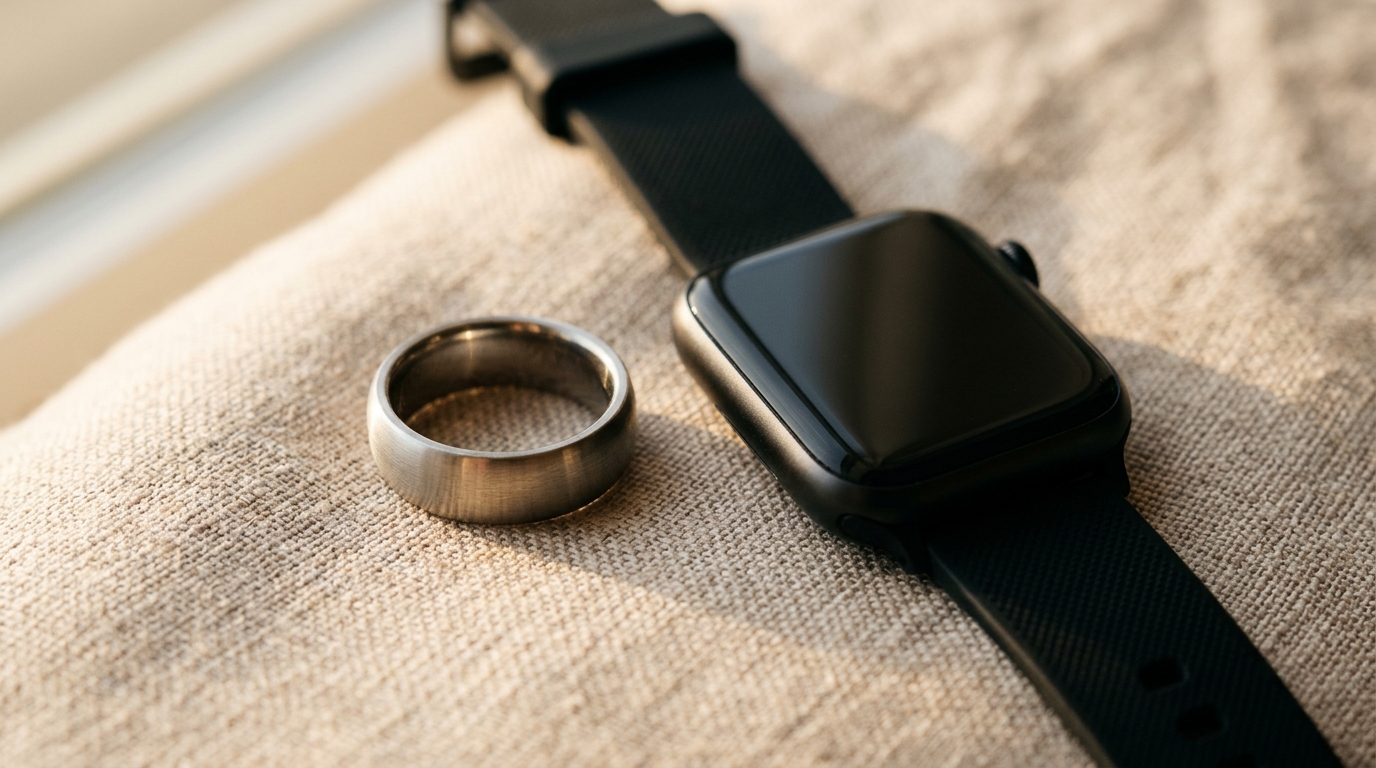
Smart ring vs smartwatch compared on overnight HRV accuracy, sleep comfort, workout GPS, battery life, and hidden subscription costs.
In this article
Sleeping with a bright, heavy smartwatch strapped to your wrist is the single biggest reason people abandon sleep tracking after two weeks. Titanium smart rings weigh under 3.5 grams, run six to ten days on a single charge, and disappear on your index finger—yet they are not a universal replacement for a GPS sports watch.
Before spending $300 to $450, here is how smart rings and smartwatches truly compare across overnight biometric accuracy, workout tracking, long-term comfort, and three-year subscription math.
Head-to-Head Matrix: Smart Ring vs Smartwatch
| Model / Option | Best For | Key Verified Specs | Typical Price Range | Key Trade-off | Check Price |
|---|---|---|---|---|---|
| Titanium Smart Ring (Oura / Ultrahuman / RingConn) | Sleep optimization, stress/HRV recovery & mechanical watch lovers | 2.4g–3.5g featherweight titanium shell6–10 days battery life; 100m water resistantOvernight resting HR, HRV, skin temp & SpO2 | $299 – $349 | + Unmatched overnight comfort—you actually wear it 365 nights a yearZero notification buzzes or glowing screens in bedPairs effortlessly with classic mechanical dress watches − No built-in GPS or live pace displayMust remove during heavy barbell deadlifts or kettlebell work | Check on Amazon |
| GPS Smartwatch (Apple Watch / Garmin) | Runners, cyclists, gym athletes & notification power users | Dual-band GNSS/GPS + optical HR + ECG1–13 days battery depending on OS vs GarminLive workout screens, maps, calls & tap-to-pay | $349 – $449 | + Accurate live pace, interval timers, and real-time heart-rate zonesFull standalone safety features, crash detection & notificationsBetter optical HR stability during intense cycling or rowing − Bulkier in bed; Apple/WearOS watches require daily charging discipline | Check on Amazon |
Why Finger Sensors Shine Overnight (And Struggle in the Gym)
Your fingers contain dense palmar digital arteries sitting just millimeters beneath thin skin—giving infrared LEDs inside a smart ring an exceptionally clean pulse waveform while you sleep. That translates into rock-solid Resting Heart Rate (RHR), Heart Rate Variability (HRV), and skin temperature deviation trends that frequently flag an oncoming cold 24 to 48 hours before symptoms hit.
However, the moment you grip a barbell, pull-up bar, or bicycle handlebar, finger tissue compresses and blood flow shifts—causing ring heart-rate readings to drop out or lag behind a chest strap or snug sports watch. Worse, hard metal-on-metal contact scratches titanium finishes quickly.
The 3-Year Subscription Math Most Buyers Miss
Smart ring batteries are tiny and sealed inside resin; realistically, expect 3 years of strong service life. Factoring in monthly memberships completely changes the value equation:
- Oura Ring 4 ($349 + $5.99/mo × 36 months): $564.64 total over 3 years.
- Ultrahuman Ring AIR ($349 + $0/mo): $349.00 total over 3 years.
- RingConn Gen 2 ($299 + $0/mo): $299.00 total over 3 years (with 10-day battery life).
- Garmin Forerunner 265 ($449 + $0/mo): $449.00 total over 3 years, with zero paywalled core health metrics.
Pros & Cons of Switching to a Smart Ring
✓ What We Like (Pros)
- Encourages healthier digital boundaries by removing wrist notifications and screen checking
- 6-to-10-day battery life means you never miss overnight sleep data because your watch died on the nightstand
- Subtle jewelry silhouette fits formal dinners, client meetings, and minimalist wardrobes
✕ What to Watch Out For (Cons)
- Cannot be resized if your finger size changes significantly over time
- Poor live workout companion compared to a dedicated GPS watch
Final Verdict
If your goal is deeper sleep consistency, illness early-warning temperature tracking, and screen-free recovery, a subscription-free smart ring (Ultrahuman Ring AIR or RingConn Gen 2) is a joy to wear every single night. If you train outdoors for races, track live gym sets, or rely on wrist notifications and payments, a Garmin Forerunner 265 or Apple Watch Series 10 remains the far more capable tool.
Frequently Asked Questions
Are smart rings more accurate than smartwatches for overnight heart rate and HRV?
Yes, often slightly more consistent during sleep. Digital arteries inside the underside of your finger sit closer to the surface than wrist vessels, and a snug ring shifts less on a pillow than a 45mm watch case.
Can a smart ring replace my running watch for outdoor workouts?
No. Smart rings lack built-in GPS chips and live pace screens, and lifting heavy knurled barbells while wearing a titanium ring risks both ring scratches and finger injury.
Which smart rings work without a monthly subscription fee?
Ultrahuman Ring AIR, Samsung Galaxy Ring, and RingConn Gen 2 all unlock full sleep staging, overnight HRV, and recovery insights with zero monthly subscription fees.
How long does a smart ring battery last before the ring needs replacing?
Because smart rings house microscopic non-replaceable lithium batteries, most hold reliable multi-day charge for roughly 2.5 to 3.5 years of continuous daily wear—making upfront + subscription math especially important.
Which finger is best for wearing a smart ring?
Manufacturers recommend the index, middle, or ring finger of your non-dominant hand for the strongest optical pulse signal and minimal daily surface scratching. Always wear the free sizing kit for 48 hours including overnight before ordering.
Can I wear a smart ring and a smartwatch together?
Yes—many athletes wear a lightweight smart ring 24/7 for sleep, HRV, and daytime dress-watch freedom, then strap on a dedicated Garmin or Apple Watch exclusively during runs and gym sessions.